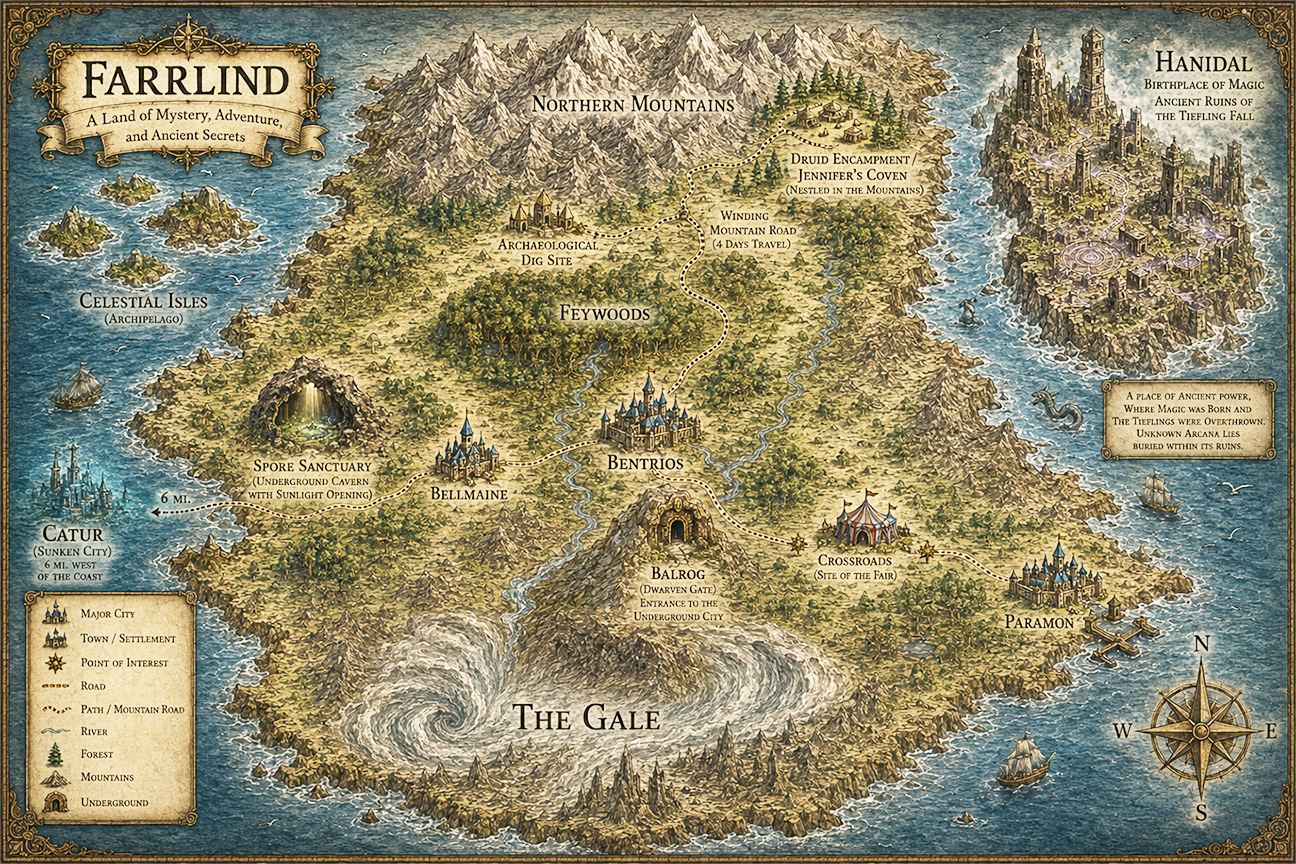
Session Eighteen — 02/22/26
1832 AS — Namal 18 (continued)
The Falling and the Forge
The figure did not argue long with gravity.
One hundred and eighty feet above stone, a dwarf fell from the highest window of the black tower — robes twisting, arms flailing not in panic but indignation. There are falls born of fear. This one felt… interrupted.
There is something deeply absurd about assigning order to chaos while a man plummets toward becoming a cautionary tale.
I seized Gildas and tore open space.
Dimension Door behaves strangely in a misaligned world. I felt resistance — not from the Weave itself, but from the unevenness of it. Some places now feel swollen with magic. Others hollowed. This stretch of Balrog felt… strained.
But the spell answered.
We blinked two hundred feet, appearing beneath the falling wizard as the tower began shedding itself in chunks. Gildas was struck by debris — wounds laid across him in an instant. I took less of it, but remained upright. I do not know whether that was luck or something watching.
“Fuck, he is falling fast.”
I have written nobler lines.
I knew that we had three breaths of time in which to deny gravity its due. Before the spellwork settled, I mended what I could — a word of healing for Gildas, and a bar or two of “The Flight of the Fairies” to remind courage where it belonged.
Brigit ran like a hunting cat closing the distance to the falling wizard. She seemed to be readying an owlbear skin, for what, I am not certain. I thought to myself in the moment, “perhaps for a makeshift parachute?!”
Mikani thought of using water somehow to help slow the dwarf’s fall, but no body of water was available. She quickly improvised and invoked Nameloa mid-stride, her spiritual trident answering before the prayer had fully left her lips. Corvinas advanced, though a roar from the tower’s crown momentarily hollowed his courage. Mikani was unfazed by the dragon’s howl.
Gildas waited.
Timing is its own magic. He was certainly aided by my song and Mikani’s blessing.
Levitate anchored to the debris field — invisible threads seizing the dwarf mid-descent. He hung suspended like a marionette whose strings had been reclaimed. He drifted downward slowly, coughing dust from his lungs as though mildly inconvenienced.
“Silly business,” he muttered.
His name: Lightdelver.
He answered in Common. In Dwarvish. In Draconic. Avoided certain questions with the precision of a man who has survived many.
“They were summoning something,” he said of those above. “I interrupted.”
He called someone an idiot.
We asked of the Well.
“In the forge. Mithril mines.”
And so we walked.
The Road Below
We passed the sleeping guard again — proof that dwarven vigilance is not immune to gravity either.
The forge rang steady — hammer on metal, as though apocalypse had taken a ticket and been told to wait its turn.
The quartermaster denied us entry until persuasion failed and urgency succeeded. The word well travels differently now. People listen when it is spoken. He was annoyed that we brought Lightdelver down here.
We were warned of Intellect Devourers. Rust Monsters. Dwarven humor.
We followed the mithril vein.
The caverns widened into brilliance — crystalline walls refracting torchlight into prismatic silence. And at its center: a pool of radiant violet like molten amethyst given thought.
It formed a face.
“Alright,” it said. “You have my attention.”
Saiffi.
A well. Bound to truth. He described himself as highly knowledgeable, though among the least powerful of the wells.
Ardor destroyed. Guson intact. Omnium on Pompadour stronger than most.
Seven elements made and govern this world:
Earth. Air. Water. Fire.
Order. Chaos. Arcana.
The elder triad made all.
Even the gods derive power beneath this ancient architecture.
We asked how to stop the Cataclysm.
“You cannot.”
We asked how to delay it.
“It is happening much too quickly.”
Dragons are signs. Tiamat’s return would be devastation — but not the event itself. Chaotix stirs. The cults seek primordial force.
There is a strange comfort in being told the end is inevitable. It clarifies the nature of effort.
Then the roar came — distant, but unmistakable.
From Balrog.
“They summoned a dragon?!” Saiffi cried. “Are they complete idiots?!”
Yes.
Yes, they are.
“How can we protect you?” we asked.
“Do you have a pan?”
Mikani offered a waterskin.
The ancient well of Balrog poured itself willingly into leather and cork.
“So now,” Saiffi said, voice echoing from within the skin, “you just need to fight the dragon.”
The City of Poison Balrog was drowning when we emerged.
Viscous black venom coated stone and street alike. Above it all — Orsydon. A black dragon with metallic sheen, arrogance thicker than his scales.
“Foolish mortals!”
I began playing The Slaying of Ryjax.
If one must face a dragon, one should at least choose appropriate accompaniment.
Near the beast stood robed figures — calm, reverent, not panicked. Lightdelver confirmed: these were the summoners.
Lightdelver, proving less useless than he first appeared, flooded us with borrowed quickness before we approached the robed fools beneath the beast. For a moment, the world seemed to move slightly slower than we did.
“We come bearing gifts,” one began.
Another tripped.
“Benjamin, dammit!”
History occasionally humiliates itself.
Their claim: Orsydon had returned to reclaim his land.
Mikani’s patience ended before negotiations began. Word of Radiance answered one cultist’s bravado with immediate regret.
“Oh come on!” he protested.
The dragon loomed. The cult postured. The sky darkened.
Ink Before Battle A dragon in the city.
A well in a waterskin.
A future tightening around us.
A Cataclysm that cannot be prevented — only softened.
There is a pattern forming, and I feel it squeezing like the press of a vice.
When Saiffi spoke of ancient wars — of dragons and gods — something inside me did not recoil.
It… remembered.
Not clearly. Not kindly.
Just enough to unsettle.
Now we must fight Orsydon.
And perhaps Benjamin.
I continue to write the truths that I remember. The truths that I can hold in my memory. My truths.