Session Fifteen - 12/21/25
1832 AS Namal 11
Coastal Aftermath
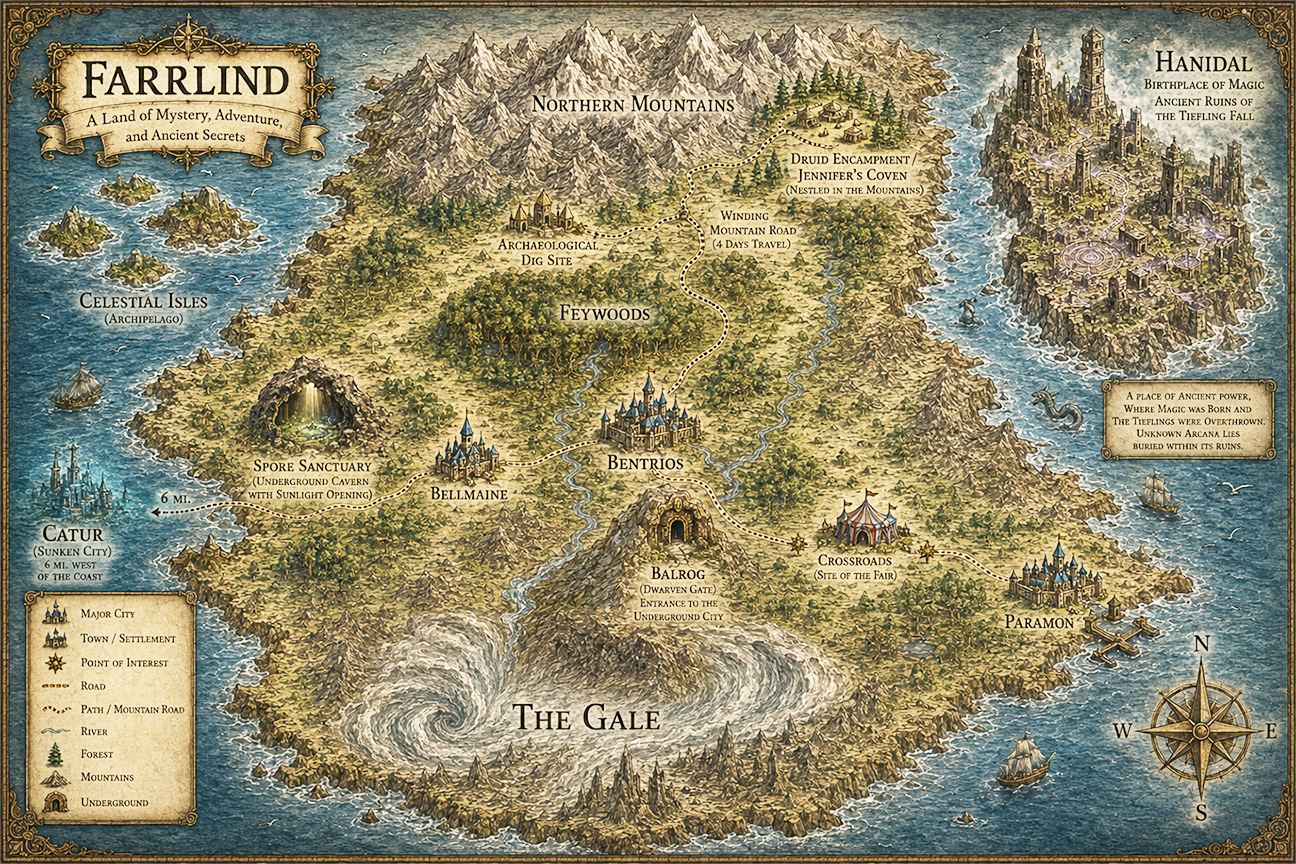
We returned to Paramon beneath a veil of mist thick enough to dull sound and soften grief. Much of the shoreline lay evacuated, boats dragged inland like startled animals seeking higher ground. Where the elemental had risen, the water still churned faintly, as if reluctant to forget what had passed through it.
Bodies were being gathered. Not many — but enough. The kind of number that leaves a silence heavier than any count aloud.
Corvinas examined the remnants of the water elemental and spoke with certainty: such beings are often guardians, bound to place rather than malice. Whatever drove this one had ridden it, not been born of it. This distinction matters. It suggests invasion, not corruption — and invasion can be repeated.
I chose words over steel.
On the shore we encountered Magistrate Kaotoa, attempting to steady a shaken populace. I composed and performed The Defense of the Watery Dunes recounting the battle not as chaos, but as resistance — not as terror, but as resolve. The crowd gathered quickly. Stories are anchors when the tide has betrayed you. I earned thirteen gold in tips, though the greater payment was the way shoulders eased as the song ended.
Brigit found drink, as Brigit does, and vanished briefly into the comforting disorder of a local watering hole.
Gildas watched the crowd with the wariness of one who has learned that symbols speak even when mouths do not. He later told Mikani he glimpsed the sigil of a chaos elemental — not celestial, but fallen. Corvinas noted two figures speaking in sharp, hurried tones before one simply… ceased to be present.
I saw the moment of disappearance.
A ripple. A distortion. The kind one notices only after long practice in watching what should not move.
I conjured light and laughter in quick succession. Dancing lights to mark the space. Tasha’s cruel gift to seize the unseen mind. The air broke, and a black-furred tabaxi collapsed into mirth, laughter tearing from him against his will as the crowd surged forward.
“Speak,” I told him.
He did.
He spoke of ancient dragonlands. Of Tiamat. Of demons not as conquerors, but as preparations. His employer seeks material sufficient for resurrection. Not of one thing — but of an age. The Cataclysm, he implied, is not a consequence.
It is a requirement.
When his laughter subsided, I let him go. Invisibility reclaimed him, and I told the others a simpler story — that he escaped me. They accepted it. I am no longer certain whether that is trust… or habit.
We returned to the Well.
What we found was not conversation, nor warning, nor face — but release. Raw arcane force thrummed through the chamber, unshaped and unkind. Mikani called upon Namaloa. I stepped back. There are moments when proximity is not bravery but hubris.
Something within the room resisted itself.
Corvinas felt it first. A pressure. A recognition. He named himself as the conflict. Power surged through him — blue light behind his eyes, arcane resonance escaping like breath from cracked stone. The backlash struck us all with psychic force, brief but intimate, as if the Well itself recoiled.
When it ended, Corvinas still stood.
That matters.
We sought rest where we could find it. Mikani and Roon went to the Temple of Namaloa. I did not follow. Some thresholds are not meant for all feet.
Later, I learned what transpired.
The head priest — Iron Paw — greeted Mikani warmly until she named the Celestial Isles. The warmth vanished. Silence was imposed. Questions about the Well were met with anger, then expulsion. Iron Paw, it seems, wears borrowed colors. He is not Namaloan.
Masks everywhere.
Elsewhere, Gildas spoke with a sapphire-eyed stranger in a tavern — a detail he mentioned only once, and then not again. I performed that night, as I often do, and the innkeeper insisted on free room and board. Music still opens doors even as truth closes them.
We slept.
Poorly, but enough.
The pattern grows clearer by the day. Wells awakened. Guardians subverted. Faiths infiltrated. Ages not merely remembered, but summoned.
And still, I write.
Because if the future must be argued for, it should at least have a record of who tried to speak for it — and who chose, at times, to remain silent.